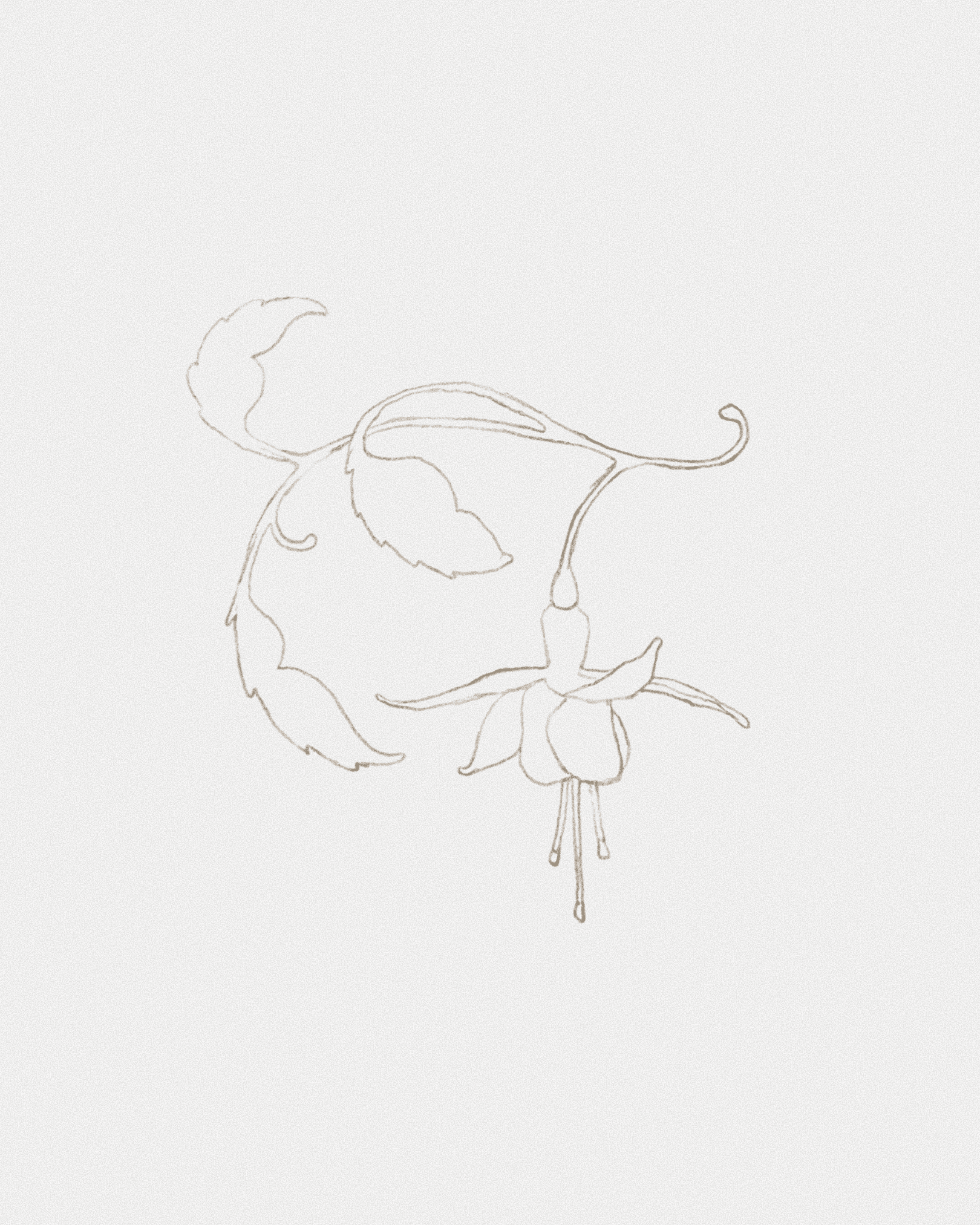
The fuchsia commands reverence across cultures; in Irish, its name is deora Dé, meaning “the tears of God,” possibly in reference to the Christian legend that the flower burst from Christ’s blood at the foot of the cross, its drooping red flowers bowing in sorrow and humility.
It seems fitting, then, that the flower’s very first recorder, , was a friar of the Order of Minims, a Catholic mendicant order aptly named for its austerity and humility—minimi. The Minims partook in a perpetual Lent, in which the members voluntarily restrained from meat and animal products in accordance with their values of compassion, reconciliation, and non-violence.
Plumier was a trained draughtsman skilled in technical botanical illustrations, known to record the plants he discovered in ink and watercolor and name them after people who inspired him (you may know of some of his other discoveries, Begonia, Magnolia, and Lobelia).
In 1696, Plumier was sent by the French crown to document the natural riches of its Caribbean possessions. Plumier’s expedition landed on the island of Hispaniola, and it was here the fuchsia appeared to him—a plant the Indigenous people called Molla Ecantu, “plant of beauty.”
Plumier would have never seen a flower like this in his life, and little did he know that his discovery would rise to major horticultural prominence in Europe nearly 200 years later. He named the flower Fuchsia triphylla flore coccineo, quite literally, “the three-leaved fuchsia with scarlet flowers,” after the celebrated botanist . Over 100 years earlier, Fuchs had compiled one of the most influential botanical books of the Renaissance, , which helped advance the field of botany through its rigorous observation, documentation, and indexing of hundreds of species.
However divine Plumier’s discovery was on Hispaniola, it nearly took an act of providence for the fuchsia to safely reach Europe. The Atlantic posed a formidable opponent to arriving back home safely, and the specimens were vulnerable to damp and decay. It was later reported that Plumier had “lost his Specimens of all things” in a shipwreck, but “preserved his Papers, as having fortunately lodged them in other Vessels.”
Since all of the fuchsia specimens and seeds Plumier had collected were lost at sea, the first documentation of the flower in European botanical literature was solely determined by his illustrations. In 1703, he published these drawings in , formally bringing the fuchsia to the public eye before his untimely death a year later, during a fourth botanical expedition.
Though Plumier’s Fuchsia triphylla was the first introduction of the species to Europe, the first species to become commercially popular was from Brazil, not the Caribbean. Named Fuchsia coccinea, it arrived in London in 1788. A similar species, Fuchsia magellanica, arrived around the same time from Chile.
From there, breeders experimented with several species, crossing the South American F. coccinea and F. magellanica varieties with the Mexican variety F. fulgens to develop hundreds of .
By the 1830s, this immigrant species was the most fashionable flower in all of England. Spilling out beyond the garden, the dangling blooms of fuchsias appeared in horticultural exhibitions, jewelry, , and illustrated publications.
By the close of the eighteenth century, fuchsias had not only exploded in popularity in England, but they had crossed the sea to American gardens.
At her family home in Massachusetts, Emily Dickinson famously kept a small conservatory of exotic plants. The variety Fuchsia hybrida was among her many flowers. In one of her poems dated to about 1862, she writes:
“I tend my flowers for thee —
Bright Absentee!
My Fuchsia’s Coral Seams
Rip — while the Sower — dreams —”
At the time, Victorian floriography was a fashionable form of communication, using flowers as an indirect way to express sentiment. The fuchsia may have represented emotional openness or a confiding of love. In this context, one could take the poem to mean that the Sower had planted a physically uncontainable feeling within their lover; which in due time rips forth like a fuchsia from its bud. How beautiful that humans look to the expressions of flowers when language no longer suffices.
The fuchsia continued to push further west, in its own Manifest Destiny. In 1929, the American Fuchsia Society was founded in , where fuchsias thrived in the cool, foggy air.
Even today, , like .